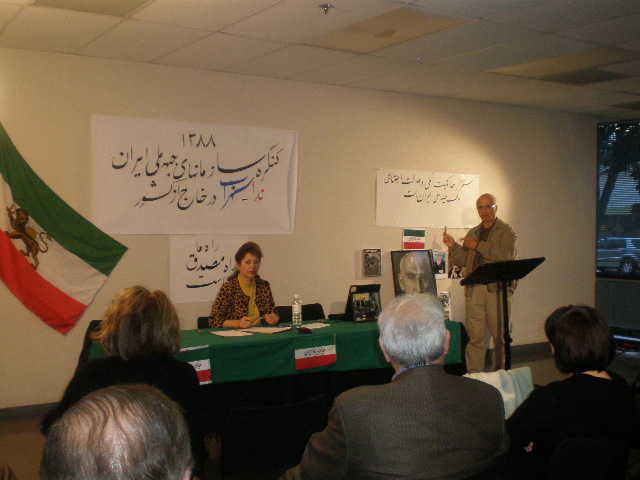
On May 25, 2009, something very
rare in Iranian history occurred. A coalition
composed of grassroots pro-democracy political
forces in Iran was formed.[1] There is little
doubt that the fundamentalist regime ruling Iran
has lost its legitimacy. There is also little
doubt that no opposition organization could on
its own establish democracy and human rights in
Iran.
The desperate need for a
broad-based coalition has animated Iranian
political activists for some time. Outside Iran,
there have been several attempts to bring
together groups and individuals to form a
powerful opposition organization with little
success. However, actual coalitions of forces
have been very rare in Iranian history.
There have been only a handful
of coalitions in the past 100 years: the
constitutional revolution of 1905, the Iran
National Front 1949-1953, and the 1977-1979
revolution.
Between 1905 and 1911, a
powerful informal coalition emerged which
included liberal and modernist intellectuals,
merchants, and a large number of Shia clerics.
This coalition opposed the absolutist monarchy
and succeeded in making a constitutional
revolution, writing a constitution and defending
it.
In 1949, many groups and
individual created a formal coalition under the
leadership of Dr. Mohammad Mossadegh. This
coalition was called the Iran National Front.
This coalition demanded free and democratic
elections, wanted to nationalize Iranian oil
from British control, and struggled to compel
the king to abide by the 1906 Constitution. This
coalition succeeded until it was overthrown by
the CIA-engineered coup in August 1953.
In 1977-1979 period, an informal
coalition emerged that opposed the Shah. This
included communists on the far left, Islamic
fundamentalists on the far reactionary right, as
well as secular liberal democrats and moderate
Islamist forces in the middle. After the
overthrow of the Shah, Khomeini succeeded in
eliminating all the others and monopolizing all
power in the hands of the ultra right wing
reactionary fundamentalists.
Various attempts to bring
together various members of the opposition and
civil society have failed so far.
The announcement of the
formation of the "Solidarity for Democracy and
Human Rights in Iran" is, therefore, a most
welcomed development for those hoping for the
establishment of freedom, democracy and human
rights in Iran. For the first time, this
coalition brings together many pro-democracy
groups, labor union activists, human rights
activists, women’s rights activists, university
student activists, prominent moderate Muslim
activists, intellectuals, and political
prisoners. In the next month or two, it will
become clear whether or not this effort will
succeed.
ACHIEVEMENTS
The formation of the Solidarity
for Democracy and Human Rights in Iran
(SDHRI) is a major achievement. Merely forming
such a coalition is a great step forward.
Iranian political culture includes excessive
individualism, self-centeredness, divisiveness,
inability to cooperate with others in a
political environment, and excessive
suspiciousness of others.
Another major achievement of
this coalition is that it includes diverse
groups and individuals. The coalition includes
the Iran National Front (INF), which has been
the main pro-democracy organization in Iran
since its founding by Dr. Mossadegh in 1949. The
INF leadership has historically tended to be
extremely cautious and has avoided adventurism
and hasty action. With the collapse of the
ideologies of communism and Islamic
fundamentalism in Iran, democracy and freedom
have emerged as the dominant ethos of large
sectors of the population. Today, the INF, as
the embodiment of Iranian liberal democracy, and
Mossadegh, as the embodiment of Iranian
nationalism, enjoy legitimacy unparalleled in
Iranian society. The dominant criticism of the
INF leadership has been its lack of willingness
to take responsibility and chart a path out of
the terribly perilous conditions endangering
Iran today.
This coalition also includes Dr.
Mohammad Maleki, who is one of the most
respected moderate Islamic political leaders in
Iran. He was the first president of the
University of Tehran after the revolution, who
spent many years in prison for his defense of
freedom in the early days of the revolution.
This coalition also includes the
Democratic Front of Iran (DFI). The DFI is led
by Hashmatollah Tabarzadi. Mr. Tabarzadi was a
prominent fundamentalist student in the
immediate years after the revolution (1979-1996)
and is an engineer by education. Tabarzadi
became disillusioned with fundamentalism and
became a democrat sometimes in the late 1990s.
His group comprises many former fundamentalists
whose age ranges between 20s and early 50s. They
engage in direct action protests. Tabarzadi has
spent many years in prison for his political
activities. The DFI has had active student
groups on many campuses.
For the first time in
contemporary Iranian politics, we have labor
union leaders join a political group. This
development is highly significant for the
success of the pro-democracy project in Iran.
There are prominent labor union leaders from two
of the most active labor syndicates in Iran: the
"Haft Tapeh Sugar Workers Syndicate" and "Vahed
Bus Drivers Syndicate."
The coalition also includes the
major secular university students groups: United
Students Front; Association of Liberal and
Nationalist University Students; student
organization of the INF; and the student
organization of the DFI.. Most university
students in Iran are very secular and
democratic, but they are not willing to get
involved in politics because they would be
expelled from the university and lose the
possibility of getting many jobs. The extremely
brave secular students represent the wishes of
the vast majority. Many of these brave students
have been put in prison and terribly tortured.
Several have died in prison under mysterious
circumstances. The most famous of this group is
the late Akbar Mohammadi who died in prison due
to sever torture, lack of medical treatment, and
hunger strike.
This coalition also includes
some of Iran’s prominent human rights attorneys,
intellectuals, human rights activists, regional
ethnic-based groups as well as smaller parties
such as the Democratic Party of Iran, and United
for Democracy.
WHY NOW?
This move at this juncture is
significant because due to the election on June
12, the regime would not want to make mass
arrests. A massive crack down on the most
prominent pro-democracy and civil society
activists at this time would greatly undermine
Ahmadinejad and the hard-liners. The reduction
of repression in the three weeks prior to the
election provides the group a window to
organize. Once the coalition has been around for
a few weeks and not repressed, it would make it
harder for the regime to all-of-the-sudden
arrest them on June 13.
The groups and individuals in
the SDHRI do not support the reformist members
of the ruling fundamentalist oligarchy. A
massive attack on the SDHRI might change the
decision of SDHRI leaders and their supporters
who may decide to vote against Ahmadinejad to
punish him. There appears to be great apathy
among the population for this election. Iranian
electorate in known to suddenly change due to an
emotional issue. The hard-liners fear that a
massive repression at this particular juncture
might cause a huge backlash against hard-liners
that would cause the people to decide to
participate in the election and vote for the
reformist members of the fundamentalist
oligarchy.
PROSPECTS
If Ahmadinejad wins the
election, then many supporters of Ayatollah
Mehdi Karrubi and Mir Hussein Moussavi (the two
reformist candidates) may become very
disappointed. Many will move away from the
reformist members and groups within the ruling
fundamentalist oligarchy. For example, the main
student group affiliated with the regime is
called Daftar Tahkim Vahdat, which has been
moving away from the fundamentalist regime and
getting closer and closer to the democratic
opposition. A win for Ahmadinejad may push many
of its members or even the entire group into the
SDHRI.
There is also a huge grassroots
women’s movement called One Million Signature
Campaign. Many leaders and activists of the OMSC
have been imprisoned and badly mistreated. In
all likelihood, the second Ahmadinejad
administration would witness a more violent
repression of this movement. On May 1, 2009,
OMSC activists joined the workers for the
International Workers’ Day celebrations. This
was the first time in recent memory that women’s
rights activists joined the labor activists. The
OMSC could join the SDHRI not only because they
both share a solid commitment to gender equality
but also to solidify support with other
democratic civil society groups. Such a
development would immeasurably increase the
likelihood of the success for SDHRI. This
alliance would also provide a real defense for
OMSC in the expected repression during the
second Ahmadinejad government.
The economic situation in Iran
is extremely bad and deteriorating. The official
inflation rate stands at 25% and the official
unemployment rate at 12%. The real numbers are
probably much higher. There have been increased
political, social and cultural repression in the
past few years. If the regime does not massively
increase repression, the SDHRI would gain more
and more support, a prospect that would end in
the downfall of the fundamentalist regime. But
if the regime immediately and massively
increases repression, then that action might
trigger mass riots.
One of the main reasons that the
regime’s repression has worked in the past has
been the lack of unity and coordination among
various civil society groups (workers, women,
students, human rights activists, pro-democracy
groups). The SDHRI breaks that deadlock. The
regime has been able to confront and easily
repress workers. The regime also could easily
represse women’s marches and activities.
However, if there are simultaneous protests,
then the regime would have great difficulties in
repressing all of them at the same time.
The regime would probably not
tolerate the SDHRI for more than a month or two.
If the SDHRI collapsed due to internal
bickering, then the regime will simply sit back
and benefit. But if the coalition remained
united, then the regime would attempt to
infiltrate it and divide it. If that method did
not work, then the regime would probably use
massive repression against them. This might
cause protests and riots by workers, students,
women, and others. The more support the Iranian
people give to SDHRI, the higher the likelihood
of a peaceful transition to democracy in Iran.
The prospects of democracy in
Iran depends in large parts to the wisdom of the
leaders and activists in this wonderful
pro-democracy coalition. It also depends on the
willingness of the Iranian people to decide that
freedom and democracy are worth sacrifice. The
continuation of dictatorship and repression in
Iran depends not only on the decisions of the
fundamentalist dictators, but also on the
decisions of the opposition leaders and the
people of Iran. Lets hope that after over 100
years of the struggles for freedom and
democracy, this time the Iranian people succeed.
Masoud Kazemzadeh is associate
professor of political science at Sam Houston
State University.