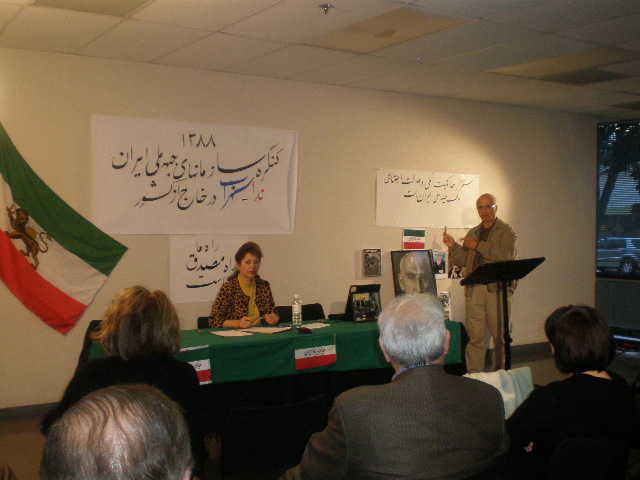
Honoring the Constitutional Revolution in Iran - 1907
The Iran Constitutional Revolution of 1907, a
democratic movement, ended the despotic rule of the old Shahs' dynasties
and their absolute rule. (At the time it was the Ghaajaar dynasty).
However, this revolution was incomplete, and a century later the
struggle for freedom and democracy continues.
The democratic movement, in the spirit of the Constitutional
Revolution, is still alive in Iran, and in the hearts of Iranians all over
the world. Its goal is to establish a democratic government where
the people rule themselves, and to forever free the Iranian people of
despots of all types.
Today this revolutionary
movement is peaceful, but it recalls the armed men on horseback, lead by
city intellectuals, tribal chiefs and supported by a large pro-Mashroute
(pro-parliamentary rule) number of Moslem clergies and other Iranian
citizen inside and outside of the country. Of the clergy some were
trying to gain more power for themselves, while others truly believed in
freedom for the people (though theirs were different concepts of freedom
and democracy).
In 1907, when the Shah,
surrendering to the peoples’ demands, signed the constitution it open
the Majles (Parliament) house to the peoples’ elected representatives.
However, the constitution was not destined to see many happy days. It was
blatantly raped by the succession of the ruling Monarchs. This
interruption to the Constitutional process started by Mohammad Ali Shah,
the successor of the signer of the decree of constitution, closed the
Majles. The bloody fights of 1908-1909 brought the victorious forces of
the freedom fighters (Mojahedin of the Mashroute) to power and thrown out
Mohammad Ali Shah out of the country and reopened the Majles.
However this golden dawn was tragically turned to a moonless night
by Reza Shah‘s British backed Coup d’etat in 1921.
The people’s fight for democracy restarted in 1320 (1942); the year Reza
Shah (after 20 dark years of his dictatorship) was abducted by Allied
forces, and replaced with his son, Mohammad Reza Shah, the last King
toppled by the popular revolution of 1979. This time the movement forged
ahead with new vigor under the leadership of Dr. Mohammad Mossadegh. Mossadegh
instituted the Jebhe Melli (Iran National Front), a pro-democratic
coalition with its main goal to oust what was all but in name a colonial regime of the British
Empire in Iran, and it had at its centerpiece Nationalization of Iran’s
Oil industry (the key to Iran’s sovereignty and financial stability).
This meant fighting the Shah and his court, the true core of the internal
reactionary system, the defenders of their foreign supporters.
Therefore this was the greatest
democratic exercise of its time; and it did not go unnoticed.
In reviewing this century of
struggle for democracy in Iran, we observe that in contrast to the
Constitutional Revolution of 1907, that the nature and character of
the1979 Revolution, which put an end to Monarchy in Iran, and the present
movement, are peaceful. However, the essence of the movement is virtually unchanged
from its beginnings, for they share a common goal: the establishment of a democratic
government. Peaceful as it may be, the unchanging demand of the movement
is to be rid of the chains of despotic rule.
This long struggle for the
democracy of our people, the people of Iran, has made us more intelligent
than ever; and able to understand and define our goals more vividly than
at any time before.
If in the dawn of the
Constitutional Revolution it was only the leaders who knew and defined the
goals, today it is the people who are leading the so-called leaders of the
democracy movement in Iran.
If at that dawn the people
believed only guns could bring them victory, today they understand the
power of the will of the people, which can help them without violence
bring about the just changes they fervently demand.
This also eliminates the risk that a victory won by a well armed
and powerful revolutionary leader would only lead to a new despot
controlling Iran.
If at the dawn of the
Constitutional Revolution only a handful of leaders knew the full meaning
of their demands and what they were actually moving toward, while the
masses only understood the weight of centuries of injustice, oppression
and cruelty by one corrupt government after another, today, leaderless but
unafraid to “destabilize” the situation and undaunted by the cruelty
of the despots in power, millions of Iranians are peacefully and steadily
moving their country toward democratic rule. Unlike their
forbearers, each of them fully understands what is at stake for themselves
and their children: the right to personal sovereignty.
In conclusion the century
old struggle for democracy, from its birth during the time of absolute
monarchs to the absolute rule of religious leaders today, is alive and
ever growing.
Honor to the long-lived struggle of the Iranian
people to establish freedom and democracy in Iran: 1285 (1907)
- Present.
Iran
National Front – US Section– Mordad 14, 1380 – August 4, 2001
|